
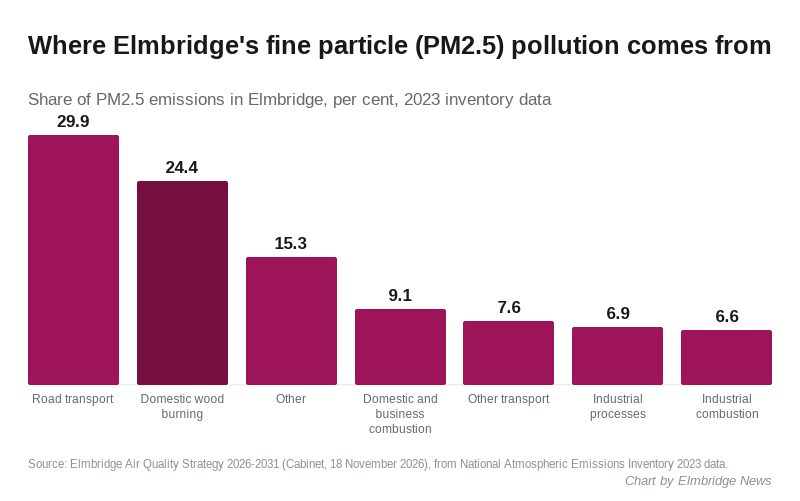
Domestic wood burning makes 24.4% of Elmbridge's PM2.5 pollution, the council's new air quality strategy says. It will look at widening the smoke control area.
Overview
Wood burning in homes produces 24.4% of the fine particle (PM2.5) pollution in Elmbridge, second only to road traffic. That is in the council’s Air Quality Strategy 2026-2031, which Cabinet approved on 18 November, subject to call-in. The council will discourage wood burning and look at widening its only smoke control area, which covers Thames Ditton Island.
Wood burners and open fires in Elmbridge homes produce almost a quarter of the borough’s most harmful particle pollution, the council says. Its new Air Quality Strategy puts domestic wood burning at 24.4% of PM2.5 emissions in Elmbridge. Road transport makes 29.9%.
Cabinet approved the strategy on 18 November. The council’s decision record shows it as “Recommendations Approved (subject to call-in)”.
PM2.5 is fine dust small enough to enter the bloodstream. The strategy says 5.7% of deaths in Elmbridge in 2024 were attributable to it. The figure for England was 5.3%, and for Surrey 5.4%.
The smoke control area
Only one part of Elmbridge is a smoke control area: Thames Ditton Island. There, chimneys must not give off smoke. Residents can burn only authorised smokeless fuels, or wood in a stove the government has approved as exempt. The strategy says breaking the rules can mean a penalty of up to £1,000.
The rest of the borough has no such restriction. The strategy says the council “will discourage wood burning and explore the feasibility of expanding the Smoke Control Area and associated enforcement policy”. That work is timetabled for 2027 to 2029, led by the Surrey Air Alliance and East Surrey Council, which replaces Elmbridge in April 2027.
The strategy also compares heating types by the PM2.5 they give off. An open fire burning solid fuel produces 2,960 grams per megawatt-hour. An Ecodesign or exempt stove produces 335. A gas boiler produces 0.72, and electric heating none at home.
Tighter targets than the law asks
Elmbridge revoked its last six Air Quality Management Areas in February. The council says there has been no breach of the national annual limit for nitrogen dioxide since 2020. Once those areas went, the law required a five-year strategy in place of the old action plan.
The strategy sets its own targets for 2031, stricter than the national ones:
| Pollutant (annual average) | WHO guideline | UK standard | Elmbridge target by 2031 |
|---|---|---|---|
| Nitrogen dioxide | 10 µg/m3 | 40 µg/m3 | 20 µg/m3 |
| PM2.5 | 5 µg/m3 | 20 µg/m3 (England target of 10 by 2040) | 8 µg/m3 |
The council has three live monitoring stations and a network of diffusion tubes. Particle monitoring on Esher High Street began in 2024.
The strategy lists 18 actions. They include:
- a Surrey-wide air quality modelling study in 2026 and 2027
- a review of monitoring so it covers schools and hospitals, in 2027
- more electric vehicle charging spaces and a bigger council electric fleet
- requiring planning applications to show how they meet the new targets
- promoting the free airTEXT pollution alerts
What it means for you
Nothing changes yet for anyone with a wood burner outside Thames Ditton Island. Any wider smoke control area would come later, and only after the feasibility work.
If you live on Thames Ditton Island, the government’s smoke control rules list the approved fuels and exempt stoves.
If you or a child has asthma or a heart or lung condition, airTEXT sends free alerts when pollution is forecast to be high.
Sources
- Elmbridge Cabinet, 18 November 2026: Draft Air Quality Strategy report, Appendix A, Air Quality Strategy 2026-2031 and decision status
Have your say